Everything about The Nature of Things, eh?

Link: Showcasing The Bugs In Your Home!

From Jim Bawden:

Link: Showcasing The Bugs In Your Home!
Usually on The Nature Of Things TV fans get to visit tropical rain forests or the frozen Canadian North or laboratories in Oxford University.But director Roberto Verdecchia had this great idea — he wanted nothing better than to visit an average Toronto home and report from there.

But director Roberto Verdecchia had this great idea — he wanted nothing better than to visit an average Toronto home and report from there.

You can see for yourself on the absolutely original hour The Great Wild Outdoors which premieres on CBC-TV Thursday, February 9 at 8 p.m. Continue reading.

Facebooktwitterredditlinkedinmail

Link: Good News: Jennifer Gardy Is Back On Nature Of Things

From Jim Bawden:

Link: Good News: Jennifer Gardy Is Back On Nature Of Things
Big news of the TV week is the return of Jennifer Gardy to CBC-TV’s The Nature Of Things with the fifth of her popular Myth Or Science specials.”The first four were all big ratings hits,” reports Dr. Gardy “but I never guessed when we started we’d be doing a fifth installment.”

“The first four were all big ratings hits,” reports Dr. Gardy “but I never guessed when we started we’d be doing a fifth installment.”

Check it out on CBC-TV Thursday at 8. Got that? Continue reading. 

Facebooktwitterredditlinkedinmail

Myth or Science: The Secrets of our Senses comes to The Nature of Things

From a media release:

DR JENNIFER GARDY’S BACK WITH MYTH OR SCIENCE: THE SECRETS OF OUR SENSES ON CBC’S THE NATURE OF THINGS, THURSDAY, JANUARY 26 AT 8PM

Dr. Jennifer Gardy, the intrepid science sleuth, returns to CBC’s The Nature of Things with the fifth in the very popular Myth or Science series. Once again she tackles the health and science claims we all wonder about, to discover whether they’re science fact or science fiction.

In this episode Gardy heads out on an international odyssey to meet an unusual group of scientists who are rewriting our understanding of how the senses really work. Although our senses are crucial to our survival, we actually know very little about them. But now there is a revolution going on. A new breed of scientists is conducting unique and sometimes bizarre experiments to trick our brain into revealing the secrets of our senses.

Does what you see affect what you feel?
Does the sound of a food change its taste?
Can we smell danger?

“This was an incredibly fun film to make,” says Gardy. “I love being the human guinea pig in our Myth or Science experiments and I was tremendously surprised to find out how easily our experimenters could fool me with some of the sensory tricks you’ll see in the show.”

MYTH OR SCIENCE: THE SECRETS OF OUR SENSES premieres on CBC’s The Nature of Things on Thursday, January 26 at 8PM (8:30PM NL).

To investigate the world of our senses, Dr. Gardy heads to the U.K to meet a magician who is also a professor of psychology at Goldsmiths University, London. Together they use the science of magic and illusion to discover whether seeing really is believing. At Oxford University, Gardy joins the neuroscientist who created the world famous potato chip test to find out if the sound of our food dictates how it tastes. Then, she travels to the University of Leeds to help create a fake lecture to uncover whether seeing images of creepy crawlies is actually enough to get us scratching.

Then there is Los Angeles, where things get really weird. Here, Gardy meets the head of UCLA’s Multisensory Perception Lab where she is tricked into adopting a rubber hand as her own, and is stabbed with a fork… all in the pursuit of understanding how our brain deals with competing information from our sense of sight and touch.

In Germany, Gardy explores whether humans, like members of the animal kingdom, can actually smell danger. At University Hospital in Aachen, she witnesses a fascinating experiment that delves deep into our brain to find out if our sense of smell can be triggered by subliminal scents created during an aggressive activity like boxing.

And of course, Gardy also tackles those questions we’ve all stayed up late wondering about, like: can we really get used to a bad smell? And, is colour just an illusion created by our brain?

“Our senses are truly remarkable,” says Gardy after embarking on this amazing mission to uncover how our senses function. “Deep inside our brain, the interconnections between each of our sensory inputs have a profound influence on how we experience the world. The work our featured scientists are doing is really helping us to explore this most human of frontiers.”

MYTH OR SCIENCE: THE SECRETS OF OUR SENSES premieres on CBC’s The Nature of Things on Thursday, January 26 at 8PM (8:30PM NL).

Facebooktwitterredditlinkedinmail

The Nature of Things explores music in “I Got Rhythm: The Science of Song”

Have I sung in the shower? The car? When I thought no one was listening? Absolutely. We all have at some point and it’s a trait humans share. We’re addicted to music, whether we’re doing it or we’re listening to someone else. But why?

The answer is explored in Thursday’s new instalment of The Nature of Things in “I Got Rhythm: The Science of Song.” Producer-director Connie Edwards and a phalanx of scientists and experts explore the impact music has on our lives.

“Ever since I was young I have always believed that music was an inherent part of being human,” Edwards says in the doc’s press materials. “As a ‘girl singer’ I saw and felt the effect that music had on people but I could never quantify it. Music has moved my soul from the beginning, but it has only been in the last 15 years or so that science appears to have taken a serious interest in why we sing, hum, warble, pluck or blow into instruments. Our team literally travelled around the world to meet with some incredible scientists and researchers who are doing ground-breaking scientific work using music. What was fascinating was how many of the scientists/researchers were also accomplished musicians.”

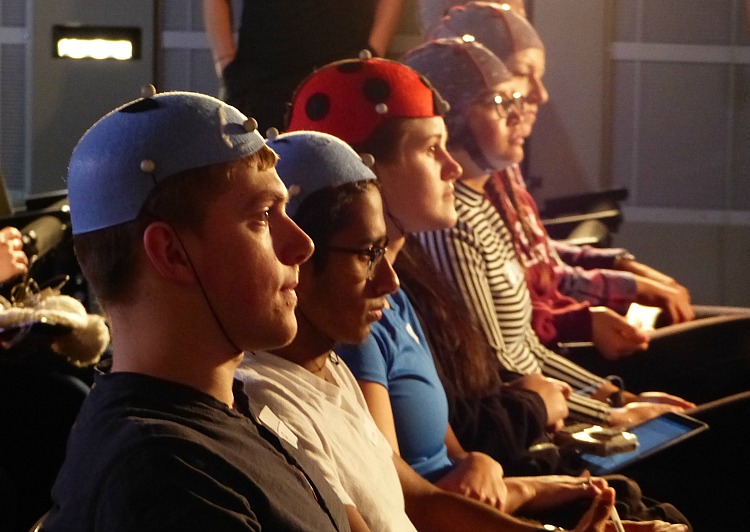
“I Got Rhythm: The Science of Song” kicks off at McMaster University, where an audience—wired to sensors—listens to a band perform two songs. One is fast-paced and more likely to initiate swaying, and the other more low-key (see what I did there?). It doesn’t take long for some interesting results to emerge. Swaying or bobbing your head to music is contagious, as is experiencing tunes together, like at a concert or public event. It’s a fact scientists have discovered dates back to the Neanderthals, who crafted flutes out of animal bone.

And, it may be that music and rhythm doesn’t just make us feel good or bad emotionally, but it could literally heal. A Gothenburg, Sweden, study explored whether listening to music would help hpatients suffering from stress-induced cardiomyopathy, a.k.a. broken heart syndrome, while another test examines how early babies recognize, react and socialize with others after experiencing rhythm.

The Nature of Things airs Thursdays at 8 p.m on CBC.

Facebooktwitterredditlinkedinmail

The Nature of Things explores the lives of “Pompeii’s People”

I’ve been fascinated with the story of Pompeii from a young age. A town full of people and animals who were overrun by the ash from an erupting volcano? It set my imaginative mind reeling. It still does, so I was jazzed to learn it was the focus of The Nature of Things‘ season return on Thursday.

“Pompeii’s People” follows host David Suzuki—who first visited the site 43 years ago on his honeymoon—as he is given unprecedented access to the Roman town, exploring the importance of the location to the Empire and the lives of its people buried under volcanic ash in 79 AD after Mount Vesuvius erupted.

Technology plays a huge part in the project, as aerial photography,  dramatic recreations, CGI and other scientific applications peel back the layers of volcanic matter to reveal a stunning, and surprisingly relatable way of life. Handel Productions and Twofour Group do an incredible job not just recreating the story behind the demise of the 12,000 residents located in the coastal town near Naples, but focusing on the well-off and working class folks walking the cobbles. No stone is unexplored, as footage includes an analysis of roadways and a warren of one-way streets and homes are digitally reconstructed to show warmly painted walls, frescoes and skylights in ceilings. Suzuki is welcomed into the former home of a fish sauce merchant, who adorned his property with mosaics of his product, showing a knack for advertising more than 1,500 years before Mad Men.

rp-cu-plaster-cast-of-people

Next up on Suzuki’s walk is the forum, where public areas offered citizens a place to converse, play games, buy goods from the open-air market or worship at the Temple of Jupiter.

The most interesting part of Thursday’s return for me was the recreation of Pompeii’s people. I think everyone has seen pictures of the plaster casts of the dog, woman and child, and man, all frozen in time and contorted after being buried in ash. Now computers are digitally removing the plaster and x-rays reveal the bones to understand what Pompeians looked like, what they ate and how they lived. It’s particularly stunning to see how the vaguely human form of a dead soldier is transformed by technology into a young man.

Also analyzed: the rearing of animals and livestock, what garbage says about what Pompeians ate and the role of sex in their society. Informative, educational and entertaining, “Pompeii’s People” is well worth checking out.

The Nature of Things airs Thursdays at 8 p.m. on CBC.

Facebooktwitterredditlinkedinmail