
Tag Archives: The Nature of Things

The Nature of Things decodes the fascinating world of body language

I know body language can give you away. The way someone sits, leans, turns their head or fidgets can betray what one really thinks despite what words are said. If a picture can say 1,000 words, what can body language tell you? A heck of a lot more than I first assumed.

That’s what I came away with after watching a screener for “Body Language Decoded.” Broadcast as part of this Thursday’s The Nature of Things, written and directed by Geoff D’Eon and created and produced by Edward Peill, “Body Language Decoded” is a fascinating peek into how our bodies communicate in the most subtle of ways.

The instalment begins with the face and 43 muscles capable of creating thousands of intricate expressions that are hardwired into the brain. Why? Facial expressions were the key component to communication between early humans. Those automatic reactions have served FBI agent Joe Navarro well; he spent 25 years reading body language for the Bureau, earning the nickname “The Spy Catcher.” And while Navarro did read faces in order to gauge what was really going on with someone, he found an unlikely source for reading body language: the feet. Part of the limbic system, our feet and bodies tell the true tale of how we’re reacting to the world and each other.

Knowledge of the limbic system comes into play for Dr. Jillian Glass, who heads to the Santa Monica Pier to do one of my favourite pastimes: people watching. It’s there she can see how a young woman’s body shows her devotion to a man, and how his posture betrays his aloofness. Toes turned towards your mate? There’s a good chance the relationship is solid.

One of the most interesting segments of “Body Language Decoded” spends time covering the art of deception and the physical signs we give off when trying to lie. Footage of former U.S. president Bill Clinton is shown denying relations with Monica Lewinsky, and Nova Scotia mother Penny Boudreau who pleaded for the return of her missing daughter, Karissa. In the former case, lies were effectively told; in the latter, Boudreau was found guilty of murdering Karissa, showcasing how the body can hide or reveal a lie.

The Nature of Things airs Thursdays at 8 p.m. on CBC.

Image courtesy of Tell Tale Productions.

Facebooktwitterredditlinkedinmail

Link: Showcasing The Bugs In Your Home!

From Jim Bawden:

Link: Showcasing The Bugs In Your Home!
Usually on The Nature Of Things TV fans get to visit tropical rain forests or the frozen Canadian North or laboratories in Oxford University.But director Roberto Verdecchia had this great idea — he wanted nothing better than to visit an average Toronto home and report from there.

But director Roberto Verdecchia had this great idea — he wanted nothing better than to visit an average Toronto home and report from there.

You can see for yourself on the absolutely original hour The Great Wild Outdoors which premieres on CBC-TV Thursday, February 9 at 8 p.m. Continue reading.

Facebooktwitterredditlinkedinmail

Link: Good News: Jennifer Gardy Is Back On Nature Of Things

From Jim Bawden:

Link: Good News: Jennifer Gardy Is Back On Nature Of Things
Big news of the TV week is the return of Jennifer Gardy to CBC-TV’s The Nature Of Things with the fifth of her popular Myth Or Science specials.”The first four were all big ratings hits,” reports Dr. Gardy “but I never guessed when we started we’d be doing a fifth installment.”

“The first four were all big ratings hits,” reports Dr. Gardy “but I never guessed when we started we’d be doing a fifth installment.”

Check it out on CBC-TV Thursday at 8. Got that? Continue reading. 

Facebooktwitterredditlinkedinmail

The Nature of Things explores music in “I Got Rhythm: The Science of Song”

Have I sung in the shower? The car? When I thought no one was listening? Absolutely. We all have at some point and it’s a trait humans share. We’re addicted to music, whether we’re doing it or we’re listening to someone else. But why?

The answer is explored in Thursday’s new instalment of The Nature of Things in “I Got Rhythm: The Science of Song.” Producer-director Connie Edwards and a phalanx of scientists and experts explore the impact music has on our lives.

“Ever since I was young I have always believed that music was an inherent part of being human,” Edwards says in the doc’s press materials. “As a ‘girl singer’ I saw and felt the effect that music had on people but I could never quantify it. Music has moved my soul from the beginning, but it has only been in the last 15 years or so that science appears to have taken a serious interest in why we sing, hum, warble, pluck or blow into instruments. Our team literally travelled around the world to meet with some incredible scientists and researchers who are doing ground-breaking scientific work using music. What was fascinating was how many of the scientists/researchers were also accomplished musicians.”

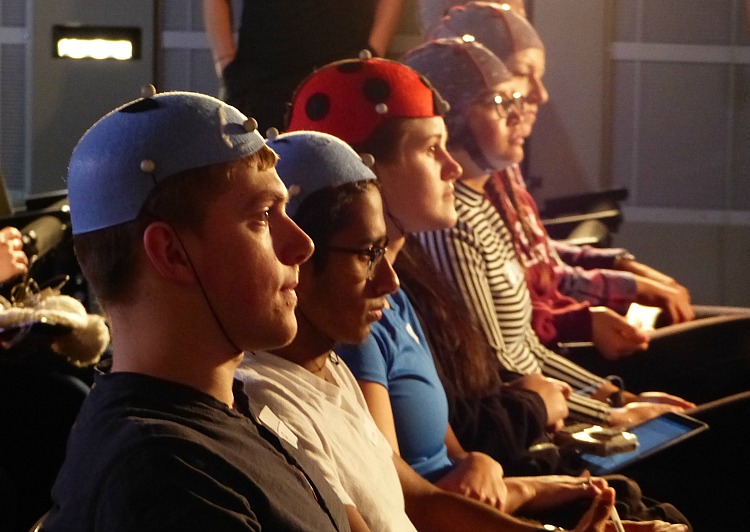
“I Got Rhythm: The Science of Song” kicks off at McMaster University, where an audience—wired to sensors—listens to a band perform two songs. One is fast-paced and more likely to initiate swaying, and the other more low-key (see what I did there?). It doesn’t take long for some interesting results to emerge. Swaying or bobbing your head to music is contagious, as is experiencing tunes together, like at a concert or public event. It’s a fact scientists have discovered dates back to the Neanderthals, who crafted flutes out of animal bone.

And, it may be that music and rhythm doesn’t just make us feel good or bad emotionally, but it could literally heal. A Gothenburg, Sweden, study explored whether listening to music would help hpatients suffering from stress-induced cardiomyopathy, a.k.a. broken heart syndrome, while another test examines how early babies recognize, react and socialize with others after experiencing rhythm.

The Nature of Things airs Thursdays at 8 p.m on CBC.

Facebooktwitterredditlinkedinmail

Link: Vital Bonds will challenge you

From Jim Bawden:

Link: Vital Bonds will challenge you
I had just about determined I would not watch Vital Bonds, CBC-TV’s new documentary on organ donors.

That’s because I had a dear friend who did not long survive his heart transplant and after a decade ago  memory is still painful to me. Then curiosity got the best of me and I thought I’d watch the first 10 minutes.

Well, the next thing I realized was I’d watched the entire hour –it’s that well made, an often brilliant pastiche of interviews with survivors and donors’ families stitched in with mini-profiles of the doctors and nurses who seem to toil around the clock. Continue reading.

Facebooktwitterredditlinkedinmail