

TV, eh? | What's up in Canadian television | Page 178
TV,eh? What's up in Canadian television

Pretty Hard Cases: Sherry White and Meredith MacNeill preview Season 1

Sherry White and Meredith MacNeill are no strangers to CBC. White’s most recent project for the network was as director, executive producer and writer for Little Dog. MacNeill, meanwhile, has just come off five seasons as co-creator, writer, producer and star of Baroness Von Sketch Show. Now the two have paired for one of the most entertaining new series on the network, Pretty Hard Cases.

Debuting Wednesday at 9 p.m. on CBC, MacNeill stars as Sam Waszowski, a guns and gangs detective—and single mom—who finds herself teamed with drug squad detective Kelly Duff, played by Adrienne C. Moore (Orange Is the New Black). Together, the pair are trying to take down a neighbourhood gang dealing drugs and weapons. Co-created by White and Tassie Cameron—who previously worked together on Rookie Blue—Pretty Hard Cases is notable not only for its tone but its focus: telling the stories of two women in their 40s.

We spoke to Sherry White and Meredith MacNeill about the first season of Pretty Hard Cases.

Sherry, can you give me the background on how the show came about? Did you and Tassie Cameron keep in touch over the years and say ‘Let’s try and find something together’?
Sherry White: Tassie and I worked on Rookie Blue together and I was on that from the first season until the end. We got really close during the making of that. We moved on to do other things and there was a couple of times when people approached me with, ‘Could I take on some young writer’s cop show and try and help elevate it.’ Somebody came to Tassie and said it, and I’m like, ‘If there’s a demand for this, why don’t we do this ourselves?’ and really reflect more where we are now in our career. Rookie Blue is more about the early days of these characters and their careers.

This show is more about women who are in their 40s, who had given it all to their career and are finding themselves a little wanting for a full life. They’ve sacrificed a lot of their own personal goals in order to have their career, which is totally where Tassie and I were. We wanted to reflect our friendship and we wanted to reflect where we were in our careers and that sort of, what next? How else do we get a full life? We also wanted to have fun. We wanted it to be more in this sort of Paul Feig kind of… the ways he can celebrate women and be really raw and honest and funny about whatever situation they’re in, and I think we accomplished that with the show.

Meredith, did Sherry or Tassie come forward and say, ‘Hey, listen, we’ve got this character for you.’ How did you end up playing the role of Sam?
Meredith MacNeill: I was approached by Sherry and Tassie for the role, so I didn’t have to audition. When I was talking to Sherry about the role, I remember the absolute shock and pleasure and being completely thrilled.
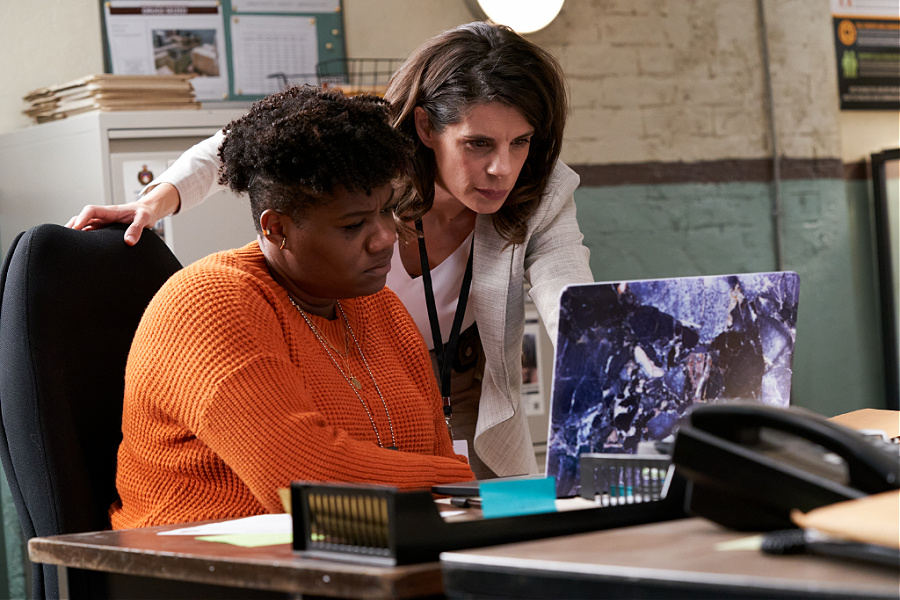
How did you decide how you were going to play Sam? Did you have to learn how to rein her in a little bit?
MM: I was really fortunate to have Sherry and Tassie, who knew my work from Baroness. Actually, there was a lot of freedom on the floor. When I got the part, we talked a lot about, in terms of the physicality and the part, and the part was really on the page. I didn’t have to deviate much from that. In terms of feeling free to do whatever I wanted to bring to it, Sherry and Tassie, I would say, they were my rein-ers. Sherry directed some episodes and because she knew my work so well and we had such a great trust I’d be like, ‘I’m going to do this.’ And she’s like, ‘Great. Do it.’ In terms of reining in my physicality, Baroness and Pretty Hard Cases are such different shows, so the way it used my physicality was a bit different.

Sherry, how tightly scripted is Pretty Hard Cases?
SW: That was one of the major questions we had going into this because we knew we wanted them to find their way and all that stuff but as everyone knows, improv can get unwieldy and we didn’t want to have 65-minute episodes. We found a really good system where we mostly stuck to the text and certainly, for all the procedural stuff, there’s not a lot of improv room in that. You need just the facts, you need what that content was. In the more personal scenes, there was a lot more play and we would always allow for [Meredith] to, once we nailed it, just go. Just do something else if you wanted to play. I would say it was mostly not improvised, but definitely, enough to bring a special flavour that Meredith and Adrienne would bring themselves.

The relationship between Sam and her son is fascinating. Can you talk about how complicated this relationship is going to be as we see this first season roll out?
MM: It’s going to be extremely complicated. Sam is desperate for attention and the love and respect of her son. I’m a single mom and my daughter’s only 10 and I’m starting to feel like she would rather be with her friends. So imagine that amplified. And then Percy [Hynes White] is incredible to play opposite of. We had good chemistry as well, so we were finding a lot about the relationship as it was going. One of Sam’s big storylines for the show is her relationship with her son. It gets pretty exciting.

SW: And again, because loneliness is a theme in this show, there is nothing more lonely than being a single mother about to be an empty nester.

MM: I was so grateful because it’s been my therapy because it’s going to happen to me. I used to call Sherry and sometimes I’d just start crying at the thought of it.

Sherry, what can we expect to see in Season 1?
SW: The core of the series is Sam and Kelly building a friendship, finding a friendship despite their differences and relying on each other, and finding this common ground as they are working together. They’re dealing with the main neighbourhood gang. But then, through that, they have personal stories that develop and challenge their professional life and vice versa. It’s a lot of fun. I think every episode brings a lot of laughs and also it can get pretty sad sometimes.

Pretty Hard Cases airs Wednesdays at 9 p.m. on CBC.

Images courtesy of CBC.

Facebooktwitterredditlinkedinmail

Coroner: Morwyn Brebner and Adrienne Mitchell on Season 3’s “strange, magical” vibe

From the opening moments of Coroner’s Season 3 premiere, it’s clear that COVID-19 has invaded Dr. Jenny Cooper’s (Serinda Swan) world. There are social distancing measures during her group therapy class, full-body protective suits at her workplace, and in one painfully familiar scene, raw marks on her skin when she removes her mask.

“Yeah, that was a striking image,” creator and showrunner Morwyn Brebner says during a phone interview. “And it really did just evoke all the images that we’ve seen of the health care workers and the hours and hours and hours that they had to work in those masks.”

Executive producer and lead director Adrienne Mitchell concurs, adding that the scene demonstrates “the truth of people trying to make their way through this, from doctors down to personal care workers in homes, and just the physical toll that that took.”

Since Coroner is a medical-crime drama that focuses on death, Mitchell and Brebner felt it was natural to incorporate COVID-19 into the new season, which kicks off Wednesday at 8 p.m. on CBC. However, aside from the first episode’s plot involving the death of a long-term care worker who lacked access to PPE, they say the pandemic will influence the ambience of the series more than its storylines.

“The weird thing about the pandemic is that … it proposes the possibility of different ways of living,” explains Brebner. “We can go into different worlds and go through them with a real sense of curiosity and wonder.”

Over the course of this season’s 10 episodes, up from last year’s eight, Jenny and Detective Donovan McAvoy (Roger Cross) will investigate a slew of mysterious deaths in a variety of new environments.

“Because it’s been a COVID-19 year, where time is stopped and everything is surreal and you’re put on pause, you can invite unusual things into your life and hold them in a way that is perhaps more playful,” says Mitchell. “That’s what’s fun about this season: You can go from horror to haunted houses to witches to strange magic.”

This season will also have a different vibe because Jenny faced down several personal demons—including her complex relationship with her dad, Gordon (Nicholas Campbell)—during the show’s dark and psychologically fraught second season, letting her approach Season 3 with a fresh perspective.

“[Jenny]’s decided to be open to life, and that makes her vulnerable, but it also presents an incredible opportunity,” says Brebner. “It’s like allowing things to come at her while she’s embracing her trauma a little and trying to see what it is to her, as opposed to being afraid of it.”

According to Mitchell, series lead Swan—who has always tackled Jenny’s mental health issues with fearlessness and compassion—was completely onboard with her character’s emotional shift.

“Serinda was very much interested in exploring trauma as a tool,” says Mitchell. “So instead of [Jenny] succumbing and being paralyzed by it, now that she has a bit more of an understanding of it, how can she use it and draw from it to move through the world and connect with people who have their own individual traumas? … It’s very interesting. It’s a different journey for her this season.”

Behind the camera, Mitchell used “flares of light and the magic of light” to visually represent Jenny’s newfound appreciation for life, choices that are evident during a trippy, drug-infused sequence in the first episode.

“Only Morwyn can write about a weed journey in the middle of a very hard COVID-19 case, but it works,” laughs Mitchell. “Because [the way we normally live our lives] is sort of on pause because of COVID-19, it allows for unusual, strange, and living-in-the-moment events to take place, and there are some opportunities to have what I would call ‘strange joy.’”

However, not everything will be rosy for Coroner’s characters this season.

According to Brebner, McAvoy will have a health scare that forces him to face his mortality in a new way.

“He deals with death all the time,” she says. “He’s a homicide detective, he’s an incredibly stoic person, and he’s up against something that’s a new kind of adversary for him.”

Meanwhile, Liam (Éric Bruneau)—who left Jenny in last season’s finale—will still be struggling with his war-related PTSD.

“We ended Season 2 with the decision that they needed to be apart to heal, and that being together was going to be an obstacle to their healing,” says Mitchell. “And then the question is, where does that take them? Is that going to bring them back together or not?”

As for Brebner and Mitchell, they’re both trying to recover after Season 3’s exhausting, COVID-delayed five-month shoot, which ended on Jan. 22.

“We brought in a COVID-19 health management team, so we had about three or four rotating nurses and daily screens, in terms of temperature and questionnaires. We also had weekly COVID tests and a strict regimen of mask-wearing at all times,” Mitchell says.

The cast and crew were also required to stay six feet apart as much as possible, which was hard, Brebner notes, because TV production “is really a business where we stand close together and hand each other things.”

Still, they both say it was a “privilege” to work during the pandemic and are proud of the result.

“We go to deep, emotional places, but we also go to a lot of fun places,” Brebner says. “This season has a really strange and magical integrity to it.”

Mitchell concludes, “It’s just weird, but it’s a cool weird.”

Coroner airs Wednesdays at 8 p.m. on CBC and CBC Gem.

Images courtesy of CBC.

Facebooktwitterredditlinkedinmail

CBC cancels Trickster

From a media release:

We have had many conversations over the last few weeks with a view to continuing production on a second season of Trickster. Those conversations included producers, writers, actors, and the author of the books on which Trickster is based.

Fully respecting everyone’s perspective, season two will not move forward as planned, unfortunately.

CBC is extremely proud we were able to bring this compelling story to the screen and are grateful to the many talented individuals who made it possible.

We are as committed as ever to telling other important Indigenous stories, of which there are many. In fact, CBC currently has eight such scripted projects in development and we look forward to sharing more details about what’s next in the coming months.

Statement from author Eden Robinson:

“One of the best parts of 2020 was watching the young, Indigenous cast soar. The outpouring of support for the first season was magical. I’m deeply grateful that CBC and Sienna respect this situation. It gives me hope that future collaborations with Indigenous creatives can be done with care and integrity.” 

Facebooktwitterredditlinkedinmail

Link: ‘Letterkenny’ inks multiple licensing deals with merchandise companies

From David Friend of the Canadian Press:

Link: ‘Letterkenny’ inks multiple licensing deals with merchandise companies
Producers of the show say they’ve struck several fresh agreements, including one with Funko, a producer of collectible figurines inspired by characters from popular franchises. Continue reading.

Facebooktwitterredditlinkedinmail

Rezolution Pictures’ GESPE’GEWA’GI: The Last Land, set in Mi’gmaq fishing community, debuts February 11 & 13 on APTN

From a media release:

Rezolution Pictures has announced the debut of the first season of APN’s original series GESPE’GEWA’GI: The Last Land, a 13-part half-hour documentary series about the Mi’gmaq fishers of Listuguj, Que., who make their living on the nearby waters harvesting salmon, crab, lobster and shrimp. While the series takes a lighthearted approach to life in Listuguj, it also provides a First Nations perspective on how a commercial fishing industry – one that was born out of violence and defiance – grew to be a key economic and cultural support for the community. Shooting began in the fall of 2018, but the subject has become topical as the conflict between Nova Scotia’s Mi’gmaq and non-Indigenous commercial fishers continues in southwest Nova Scotia.

The series will premiere in Mi’gmaq on Feb. 11 at 7 p.m. CT on aptn n and on Feb. 18 at 7 a.m. ET on aptn e/hd and 7 a.m. MT on aptn w.
The English premiere will be on Saturday, Feb. 13 at 7 p.m. ET on aptn e/hd, 7 p.m. CT on aptn n and 7 p.m. MT on aptn w.

Set against the beautiful backdrop of Canada’s world-renowned Gaspé Peninsula region in Quebec, GESPE’GEWA’GI: The Last Land is fast-paced, funny and intimate. Experience a devotional journey with the fishers of Listuguj as they battle long days and nights on the water. The community of Listuguj is a small but feisty reserve on the border of Quebec and New Brunswick. Their success has been hard won over the years: clashes with police, raids and court cases all played a role in the birth and development of the humble fishery that is now a multi-million-dollar enterprise. Everything here has a connection to fishing, from self-governance and environmental sustainability, to bringing back the annual powwow and the Mi’gmaq language to younger generations.

GESPE’GEWA’GI: The Last Land is a character-driven documentary series that explores the intergenerational sacrifice, dedication, and the heart of the Mi’gmaq fishers on the east coast of Canada. Tune into this compelling and dynamic series that glimpses into a region and culture rarely seen on television, in one of the most beautiful places in the world.

APTN has confirmed the development of the second season of GESPE’GEWA’GI: The Last Land.

GESPE’GEWA’GI: The Last Land is co-executive produced and co-directed by Ernest Webb and Greg Lawrence, produced by Lisa M. Roth. It also introduces director trainee Heather Condo, who directed the Wapikoni short film, “My Father’s Tools” which screened at Sundance and festivals around the world.

Facebooktwitterredditlinkedinmail